
Reconstruct Forrest County's Prior-Owner Timeline
Build a working timeline before you search backward at all. Each row should record one conveyance, not every instrument that happens to carry a familiar name.
| Source | Years It Covers | Where Held | What It Shows |
|---|---|---|---|
| Latest deed | Current grantee, prior grantor | Type, date, legal description, book/page | Starting transfer |
| Prior deed | Prior grantor as earlier grantee | Same land description and earlier date | Next owner backward |
| Probate or court transfer | Estate, heirs, commissioner or trustee | Case and recorded instrument references | Non-sale passage |
| Plat and deed book | Subdivision, lot and historical parties | Map book, lot/block, volume/page | Offline time depth |
Start with the Forrest County Deeds and Records Link. It covers modern transfers, but the internet index is unofficial, so keep every reference handy for confirmation at the courthouse.
The 1970 Line in Forrest County Owner History
The Land Title Association of Mississippi reports Forrest County's online land-record index as 1970 to present. That line marks web access only. The county's books reach much further back. Owners before 1970 require the Chancery Clerk's direct and reverse indexes, deed volumes, sectional indexes, map and plat books, or archive and microfilm help.
The deed search screen offers several routes inward. Search by grantor and grantee, book/page, filing date, section-township-range, subdivision, and instrument number.
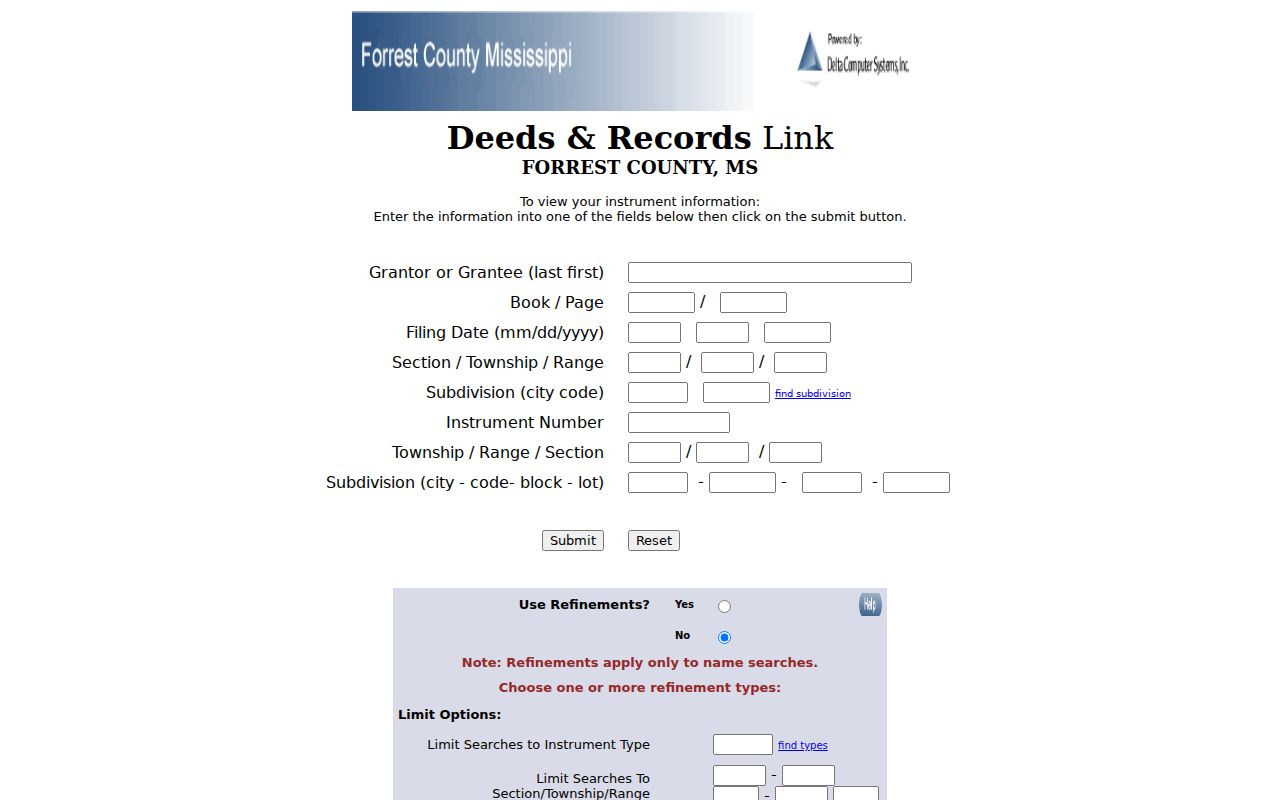
Those fields carry a prior owner backward even when a modern street address appears nowhere in an older instrument. Addresses, after all, were rarely the point of early deeds.
Online cutoff. The reported web index begins in 1970; older ownership belongs in courthouse books, historical indexes, plats, and archival sources.
Keep Forrest County History Tied to the Land
A legal description anchors each former owner to the same land. In a subdivision, carry the city code, subdivision, block, and lot through every search. Rural land turns on section, township, and range or metes-and-bounds calls. Book/page and instrument numbers then separate a true conveyance from mortgage paperwork.
Neighborhood labels can mislead. A name like North Main, Parkhaven, Petal Village, or Pecan Lakes may help you locate a plat. It is not always the recorded subdivision. Start with the informal place name. Then reach the plat and legal description. Only after that should anyone join the prior-owner timeline.
Sort Transfers from Forrest County Encumbrances
A deed of trust can look like a sale. Read only the party names and it deceives you. The same span of years may hold a warranty deed. It may also hold a deed of trust, assignment, substitution, and release. Record the instrument type and each party's capacity. A lender or trustee in a security document is not automatically a former owner.
Corrective deeds repair a name or description without any sale. Quiet-title, partition, probate, and commissioner's instruments can move interests outside the simple buyer-and-seller pattern. If the chain breaks, search the Chancery case index. Search by party, date, docket, or file number. Then reconnect the resulting order or deed to the land index.
Walk the Forrest County Deed Chain Backward
Start from the verified current deed, then reverse the parties in a controlled sequence.
- Locate the current owner's acquiring deed and verify the legal description.
- Record its grantor as the immediately prior owner.
- Search that grantor as grantee and find the earlier acquiring conveyance.
- Repeat, then run a forward check to catch corrective deeds or name variants.
- Grantor / grantee
- The conveying and receiving parties.
- Chain of title
- The ordered sequence of instruments affecting the land.
- Reverse index
- An index arranged to find grantors or grantees by party name.
- Quitclaim / warranty
- Different deed forms whose legal effect must be read from the instrument.
Bridge Forrest County Ownership Through Probate
An owner chain does not always show a clean sale between generations. People die. Property moves through estates. A will, an administration, an heirship ruling, a partition, or an executor's deed can explain why the next recorded grantee differs from the expected family name. The Forrest County Chancery Clerk keeps probate and estate files alongside the land records. The gap usually has a paper trail. Search the deceased owner and the estate representative in the Chancery case index, then tie the case number, certified order, or fiduciary authority to a recorded deed on the same legal description.
Read the capacity printed beside every name. An executor, administrator, commissioner, or trustee signs under stated authority. That signature does not make the signer an owner. A divorce decree or partition order may assign an interest, yet the certified order or later recorded instrument must still match the parcel. Estates create good clues. Keep the death date. Keep the probate reference. Keep the ownership conclusion tied to recorded instruments.
Use Directories as Clues, Not Owner Proof
Old directories help when parcel searches fail. The Mississippi Department of Archives and History catalog lists a 1912 Hattiesburg city directory on microform. A later Hattiesburg-Petal continuation exists too. The Hattiesburg Area Historical Society, local libraries, newspapers, and obituaries can surface an older street name, house number, business occupant, spouse, or family link. These sources shine when a road was renamed or the historic address no longer matches the assessor roll.
An occupant is not an owner. Remember that. Write down the directory year, printed address, exact name, and source. Use that note to find a subdivision plat, deed party, probate file, or legal description. Then confirm the candidate. Check the direct or reverse deed index. A directory entry is a clue. It is not a title conclusion.
Note: Historic sources sharpen the deed search, but only the recorded land trail proves a former owner in the chain.
Resolve a Broken Forrest County Deed Chain
A missing link in a Forrest County deed chain often comes down to indexing. The problem is usually the name itself. Retry the party search with initials, former surnames, entity names, and trustee phrasing. Widen the filing-date windows too. Then abandon the name and search the land itself. The Forrest County property records portal can be queried by subdivision, city-code-block-lot, section-township-range, book and page, or instrument number. Any of those routes can slip past a misspelled grantor or an inconsistently indexed grantee. Corrective deeds, releases, plats, and neighboring descriptions may reveal a split, a merger, or a changed legal description.
If the gap still will not close, take it to court records. Quiet-title, partition, probate, lien, and foreclosure matters all live in Chancery. The clerk can check the official Land Records Index at the courthouse. Write down exactly what coverage was searched. Note which query variants were tried, and which interval remains unexplained. A gap should stay labeled a gap. Never paper over it with a tax-roll name or a family-story guess.
Before Forrest County Existed in 1908
Forrest County was carved from Perry County's Second Judicial District in 1908. A deed chain that runs past that year can begin in Perry County property records. It can then cross into a later Forrest County instrument. Old city directories, newspapers, and obituaries help recover vanished street addresses and odd name spellings. Still, an occupant clue must lead back to a deed or plat. The Mississippi Department of Archives and History catalog lists a 1912 Hattiesburg city directory on microform. That is a useful starting point.
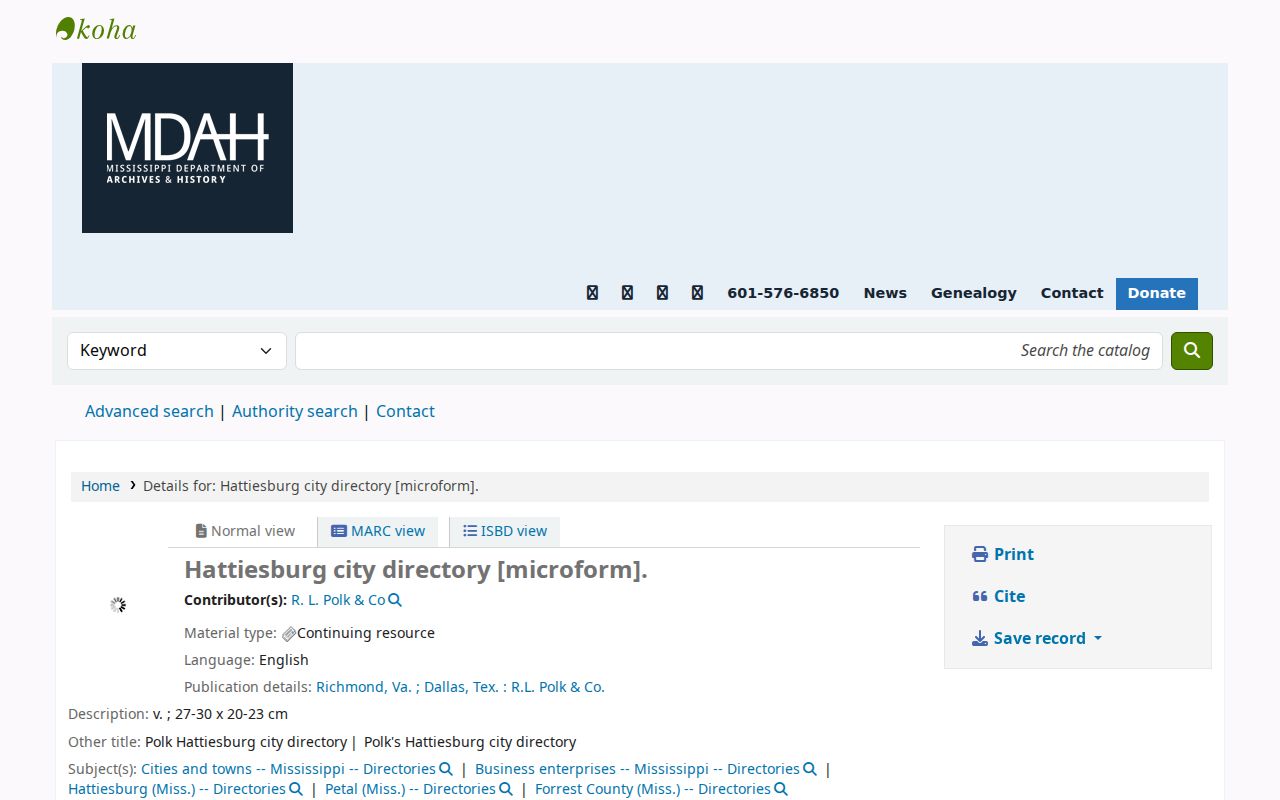
A directory can bridge an obsolete street name to a legal-description search. It cannot turn a listed resident into an owner of record. Only a recorded instrument can do that.
Probate is the other common break in a tidy sale-to-sale chain. Search Chancery estate files for wills, administrators, heirs, partition orders, and commissioner's deeds. Then go back to the land index for the resulting recorded transfer. The Chancery Clerk keeps direct and reverse indexes, sectional indexes, deed and deed-of-trust volumes, plats, lis pendens, and tax-sale records. Will books and Chancery dockets sit under the same roof. That depth matters when a former owner simply drops out of the sale sequence. One courthouse request can tie a probate case and a court order to the later deed through exact references.
Historic tax rolls and directories supply leads, not title conclusions. A tax roll names the person assessed in a given year. A directory places an occupant or business at an old address. Neither proves ownership. Treat each clue as a search term. Then demand a deed, probate transfer, patent, or judicial instrument tied to the legal description before accepting it.
For a broken trail, record the last successful transfer in full. List the parties, instrument type, filing date, description, and book and page. Ask at the courthouse for the earlier reverse-index entry and the corresponding deed book. Posted fees run $0.50 per page for staff-made copies, $0.25 per page when another person makes them, and $1 per document for certification. Current Forrest County charges should be confirmed. A precise Public Records Act request should state the parcel identifiers, record series, years, and delivery format. Request an itemized estimate, because actual search, review, duplication, and mailing costs are allowed. Avoid sweeping requests for everything under one surname, since those invite false matches and needless expense.
Finish with a forward check. Walk from the earliest verified owner through every later grantee. Confirm the legal description stays consistent at each step. This sweep catches corrective instruments, spelling variants, changed names, and estate or entity transfers. It also shows where a gap calls for title expertise rather than another round of name searching.
Lawful use. Former-owner research supports house history, estate work, and property diligence. Never use it to track, stalk, harass, or harm a living person.